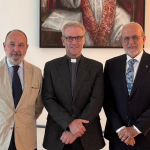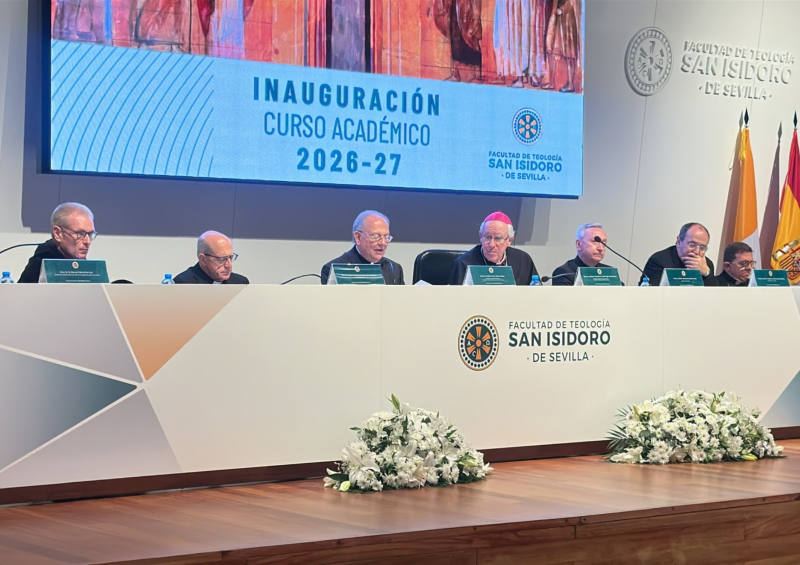
On Thursday, 1 October, the Faculty of Theology Saint Isidore of Seville held the solemn opening ceremony for the new academic year, an event that brought together the academic and ecclesiastical community for the celebration of the Eucharist, the presentation of the report on the previous academic year, and the inaugural lecture, delivered by His Excellency and Most Reverend Monsignor Fabio Fabene, titular archbishop of Montefiascone and secretary of the Dicastery for the Causes of Saints.
The day began in the Main Chapel of the Metropolitan Seminary with the celebration of the votive Mass of the Holy Spirit, presided over by His Excellency and Most Reverend Bishop José Ángel Saiz Meneses, Archbishop of Seville and Grand Chancellor of the Faculty, and concelebrated by Bishop Fabio Fabene, Titular Archbishop of Montefiascone and Secretary of the Dicastery for the Causes of Saints; the Bishop of Huelva, Bishop Santiago Gómez; the Bishop of Coria-Cáceres, Bishop Jesús Pulido; the Bishop of Asidonia-Jerez, Monsignor José Rico Pavés; the auxiliary bishop of Seville, Monsignor Ramón Valdivia; the Dean of the Faculty, Manuel Palma; and a large group of priests, including members of the Faculty’s teaching staff.
In his homily, Bishop Saiz Meneses framed the start of the new academic year in the light of Pentecost and recalled that the Holy Spirit is at the origin of the Church and also accompanies the mission of an institution dedicated to ‘reflecting on the faith’. The Grand Chancellor emphasised the close relationship between the knowledge of God, love and proclamation, pointing out that theological study cannot be reduced to the mere acquisition of knowledge, but is called to lead to authentic wisdom and to form disciples capable of proclaiming Christ through both word and life.
In this regard, he invited the entire academic community to approach the new academic year as ‘tireless seekers of the Truth’ and ‘joyful witnesses to the love that gives reason to our hope’, placing the Faculty’s teaching, research and formation work under the guidance of the Holy Spirit.
Report on the 2025–26 academic year
Following the Eucharistic celebration, the Faculty’s Assembly Hall hosted the academic session, which began with the presentation of the Annual Report for the 2025–2026 academic year, reflecting the intense teaching, research, cultural, pastoral and institutional activity carried out during the past academic year.
The report highlighted an academic year characterised by the consolidation and growth of the Faculty’s activities. Alongside the delivery of the various degree programmes and the organisation of numerous seminars, conferences and activities promoted by its departments and chairs, particular emphasis was placed on the implementation of the 2025–2030 Strategic Plan, the strengthening of relations with other academic and ecclesiastical institutions, and the work carried out to support students through scholarships and study grants.
The document also covered the Faculty’s research and publishing activities, the expansion of the Benedict XVI Library, and the various pastoral and institutional collaborations undertaken during the academic year.
Monsignor Fabio Fabene: holiness and beauty as a path to God
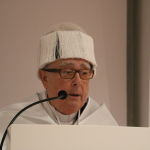
One of the highlights of the academic session was the inaugural lecture delivered by Monsignor Fabio Fabene, Secretary of the Dicastery for the Causes of Saints, entitled ‘“Choosing examples of a good life” (Leo XIV). Challenges and mission of the contemporary Church’.
In his address, Monsignor Fabene explored the relationship between holiness and beauty and presented the via pulchritudinis — the way of beauty — as a privileged path to drawing closer to God. Christian beauty, he explained, cannot be reduced to a merely aesthetic category, but rather points to the truth and goodness of God. Similarly, holiness does not consist solely in moral perfection achieved through human effort, but in a progressive conformity to Christ through the action of grace.
Drawing on authors such as Saint Augustine, Saint Thomas Aquinas and Hans Urs von Balthasar, Monsignor Fabene showed how the Christian tradition has recognised in beauty a unique capacity to elevate human beings towards the mystery of God, and how the lives of the saints constitute one of its highest expressions.
His reflection also touched upon some of the challenges specific to our time, particularly those arising from the digital revolution and artificial intelligence. Faced with the possibility of artificially producing increasingly convincing forms of beauty, he emphasised the importance of safeguarding an authentically human beauty, linked to truth, reality, gratuitousness and personal encounter.
The figure of Antoni Gaudí and the Basilica of the Sagrada Família served as a concrete expression of this relationship between art, faith and holiness. Monsignor Fabene presented the architect’s work as an example of a beauty capable of becoming a language of faith and of leading, through the visible, to an encounter with God.
In concluding his address, he expressed his hope that the San Isidoro Faculty of Theology in Seville might offer a philosophical and theological contribution to the development and formulation of a spirituality for the 21st century, building upon the foundations laid by the magisterium of Pope Leo XIV.
The solemn ceremony concluded with the official opening of the 2026–27 academic year, presided over by Monsignor José Ángel Saiz Meneses, Grand Chancellor of the Faculty, on behalf of the Holy Father, Pope Leo XIV, thus officially marking the start of a new year of teaching, research and service by the Faculty to the Church and to society.